The Shadow Ban of Truth: How Freelance Journalists Are Silenced by Algorithms — And Why Big Tech Has Become the Ministry of Narrative
A dive into how journalism is not as free as it seems.
MODERN AFFAIRSJOURNALISM
DION
6/9/20253 min read
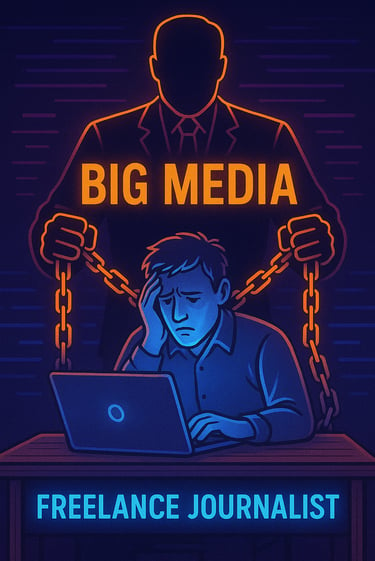
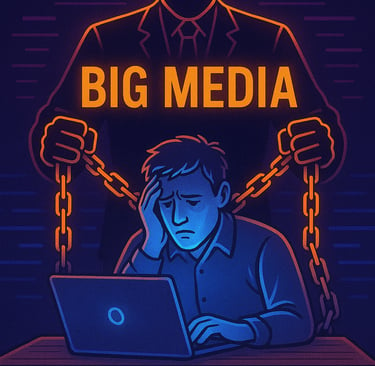
In an era where information is power, the gatekeepers of that information have become de facto sovereigns of public perception. Freelance journalists and alternative news outlets once promised a new dawn of diverse voices and digital democratization. Yet today, many of those same voices find themselves increasingly shadowbanned, demonetized, or deplatformed — not by governments directly, but by the opaque decisions of algorithmic overlords.
This piece explores how freelance journalists are routinely suppressed online, not because of violations of law, but because their content deviates from unofficial but inviolable narrative norms. It also dives into the dangerous evolution of Big Tech from neutral platforms to centralized publishers of preferred ideology.
I. From Liberation to Lockdown: The Rise and Fall of Independent Media
When YouTube, Facebook, Twitter (now X), and Medium rose to dominance, they promised an internet where anyone could have a voice. Blogs outpaced newspapers. Podcasts rivaled talk radio. Video journalists reached millions from their bedrooms. The Fourth Estate was no longer reserved for the elite. But with that power came fear—from governments and corporate media alike.
In response, a new class of algorithmic enforcers emerged:
"Harmful content" labels applied not to protect users, but to gatekeep controversial perspectives
Demonetization triggers for even mentioning taboo topics (e.g., war, vaccines, surveillance, elections)
Shadowbanning where posts are algorithmically buried despite high engagement
"Trust & Safety" teams empowered to de-rank or delete anything deemed risky
Freelancers, unaffiliated with media empires, became easy targets. Without a legal department, a verified badge, or mass appeal, their entire income and audience could vanish overnight—often with no warning or recourse.
II. The Illusion of Neutral Platforms
Big Tech giants claim to be "platforms, not publishers," yet their actions speak otherwise. A publisher is legally liable for content, but also retains the right to editorialize. Platforms, in contrast, are conduits for public expression. In practice, however:
YouTube removes dissenting scientific opinions while promoting mainstream narratives.
Facebook curates trending news and flags alternative sources under its “fact-checker” regime—often funded by legacy media.
Twitter/X pre-Elon Musk era was notorious for banning users based on ideology or proximity to controversial topics.
Even platforms like Patreon and Substack have, at times, removed creators based on pressure from external campaigns or accusations not formally adjudicated.
The result? Platforms claim editorial freedom without the accountability of publishers, and freelancers lose access to the infrastructure that built their careers.
III. The Weaponization of Community Guidelines
Community guidelines sound fair—until you realize they’re wielded selectively. One journalist’s investigative series on biolab funding gets removed, while another’s glowing documentary on the same topic gets algorithmic amplification.
“Violates community standards” is the modern-day “heretic” stamp—broad, vague, and retroactively applied. Examples include:
Independent coverage of civil unrest labeled as incitement
Documented whistleblower leaks flagged as “unauthorized disclosures”
Investigative threads on corruption tagged as “misinformation” before fact-checks even finish
This selective enforcement undermines public trust and makes survival as an honest freelancer nearly impossible without self-censorship.
IV. The Cost of Silence: Economic & Psychological Toll on Freelancers
Behind every censored post is a real person—often one whose livelihood depends on open access to digital platforms. Shadowbans aren’t just about reach; they are economic sanctions against individuals.
Demonetization eliminates income
Content throttling destroys traffic
Account strikes reduce discoverability and damage reputation
The psychological toll includes isolation, fear of speaking freely, and burnout from constantly adapting to ever-changing rules.
V. Conclusion: A Sovereign Internet Requires Sovereign Infrastructure
To defend the future of journalism, we must break the monopolies that decide what truth is. It is no longer enough to fight for free speech—we must fight for free reach, free monetization, and free association.
Decentralized content platforms, blockchain-bound identity, and tokenized journalism offer a way forward. But awareness is the first step. We must expose the shadowban-industrial complex for what it is: a system of narrative control hiding behind the mask of safety.
The journalist of tomorrow must be sovereign—not just in voice, but in code, infrastructure, and distribution.
The fact that even AI can see that there is something wrong with how journalism and free speech is affected by the big dogs deciding what people should hear versus what they shouldn't, in a manner of which that dictates the flow of whatever narrative they are positing, should be a clear indicator that something needs to be done in some fashion.
The fact that this still remains a problem is something that must be taken care of before it's too late to do anything about it.
Freedom of the press should not be limited to those that push a common narrative or agenda. Free speech is part of the 1st amendment for a reason.
Whether AI generated or human written, we all should be aware of what has been taking place for a long time.