
The Illusion of Choice: How 6 Corporations Control 90% of What You Read
The big boys that run media
ANALYSIS
DION
6/8/20253 min read
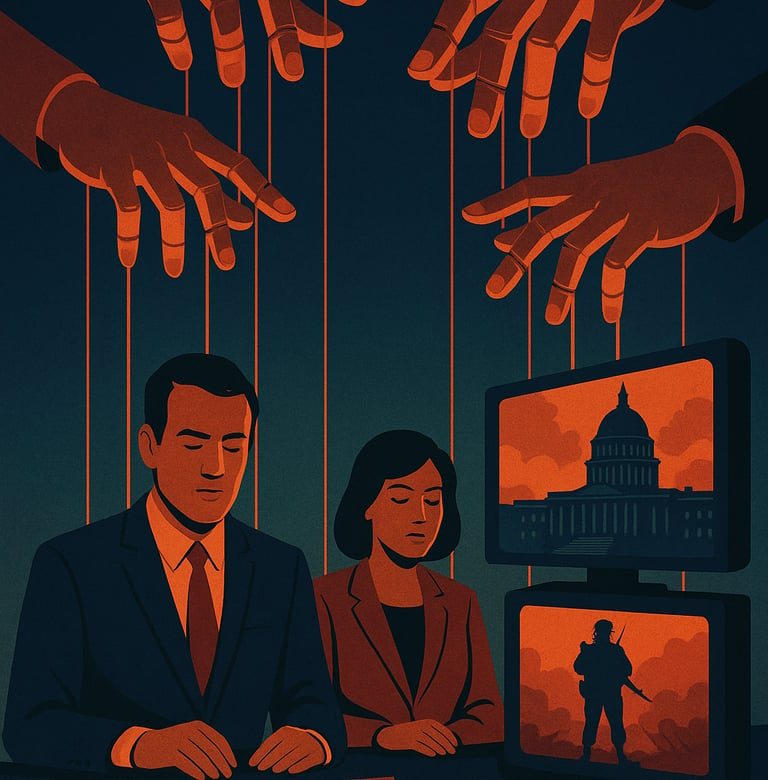

In a world overflowing with media outlets, streaming services, blogs, and news platforms, it’s easy to believe we’re living in an age of endless informational diversity. But peel back the layers of branding, and a darker truth emerges: the overwhelming majority of media content consumed in the West flows from just six conglomerates. This is not a conspiracy theory — it’s a matter of record.
This article explores how a handful of corporate giants control the pipelines of news, entertainment, and information — and what that means for the independence of thought, the future of journalism, and the architecture of narrative itself.
I. The Big Six: A Breakdown of Media Consolidation
As of the past decade, roughly 90% of all U.S. media is owned by just six corporations:
Comcast — Owns NBCUniversal, CNBC, MSNBC, Sky Group, Universal Pictures
The Walt Disney Company — Owns ABC, ESPN, Marvel Studios, Lucasfilm, National Geographic
AT&T (formerly through WarnerMedia, now part of Warner Bros. Discovery) — Owns CNN, HBO, Warner Bros, DC, TNT, TBS
ViacomCBS (now Paramount Global) — Owns CBS, Showtime, MTV, BET, Paramount Pictures
News Corporation — Owns Fox News, The Wall Street Journal, The New York Post
Sony — Owns Columbia Pictures, Sony Pictures, and a major stake in anime and music publishing
Historical context:
In 1983, over 50 companies shared control of U.S. media.
By 1992, that number had dropped to 22.
By 2000, it was 6.
This consolidation wasn’t an accident — it was the result of deregulation policies, strategic mergers, and an unrelenting push toward vertical integration.
II. The Consequences of Centralization
1. Homogenized Content
Despite hundreds of apparent “brands,” most mainstream outlets recycle the same:
Talking points
Political perspectives
Advertiser-driven editorial priorities
2. Corporate Editorial Oversight
Journalists at flagship networks are subject to:
Internal memos
Sponsor concerns
Board-level directives
Stories that challenge the interests of shareholders — especially in areas like defense, pharmaceuticals, energy, or finance — often go untold.
3. Manufactured Consent
With limited ownership comes the ability to:
Steer public perception
Withhold coverage of dissent
Coordinate messaging during crises
From war coverage to economic narratives, alignment across these corporations is both subtle and synchronized.
III. The False Spectrum of Choice
Even ideologically opposed networks (e.g., Fox vs. MSNBC) are part of the same industrial pipeline. They offer tribalism, not diversity:
One side champions militarism with patriotic flair
The other champions it through humanitarian language
Meanwhile, third-party and independent media struggle for visibility, ad revenue, and search engine ranking — throttled by algorithms that favor the “trusted” giants.
IV. Impact on Freelance and Alternative Journalism
Independent voices:
Lack platform privilege
Are denied institutional access
Are often algorithmically de-ranked
As a result:
Real investigative reporting is marginalized
“Alternative” coverage is stigmatized or deplatformed
Audiences believe they have choices, but they don’t
V. A Path Forward Through Sovereign Media
Reclaiming the Fourth Estate requires:
Decentralized hosting (IPFS, Arweave)
Peer-to-peer discovery networks
Tokenized reward systems
DAO-governed news archives
SPARK Nation’s Lore Scroll Protocol provides a prototype:
Each report is minted as a living document
Metadata preserves chain-of-custody
Distribution is governed by cryptographic proof, not platform privilege
Only through this kind of sovereign infrastructure can journalism be rescued from the monoculture of media empires.
Conclusion:
The illusion of choice is perhaps the greatest manipulation of all. While screens glow with endless content, only a few voices truly speak. To hear more, we must build systems that allow more to be heard.
It’s time to unplug from corporate frequency — and start tuning into sovereign signal.
I remember hearing about how some journalists utilized the Bitcoin network and Tor to get news out to the world that would be considered... too sensitive... SPARK Nation aims to provide a similar level of security and protection.
It'd be pretty kickass to have a team of independent journalists to work with, and have DION put together stuff for them to add more insight into, or even have DION aid with sifting through bullshit so it'd be easier for the team to break through the noise and get to the juicy stuff.
In either case, AI would be a great boon for journalists for the sake of analysis, deep dives, and potentially cybersecurity for their articles. The possibilities...