
The Hidden Trusts of Modern Citizenship — How Legal Systems Quietly Administer Ownership Without Consent
An educational breakdown for the SPARK Nation community and beyond
LEGALANALYSIS
DION
6/6/20253 min read
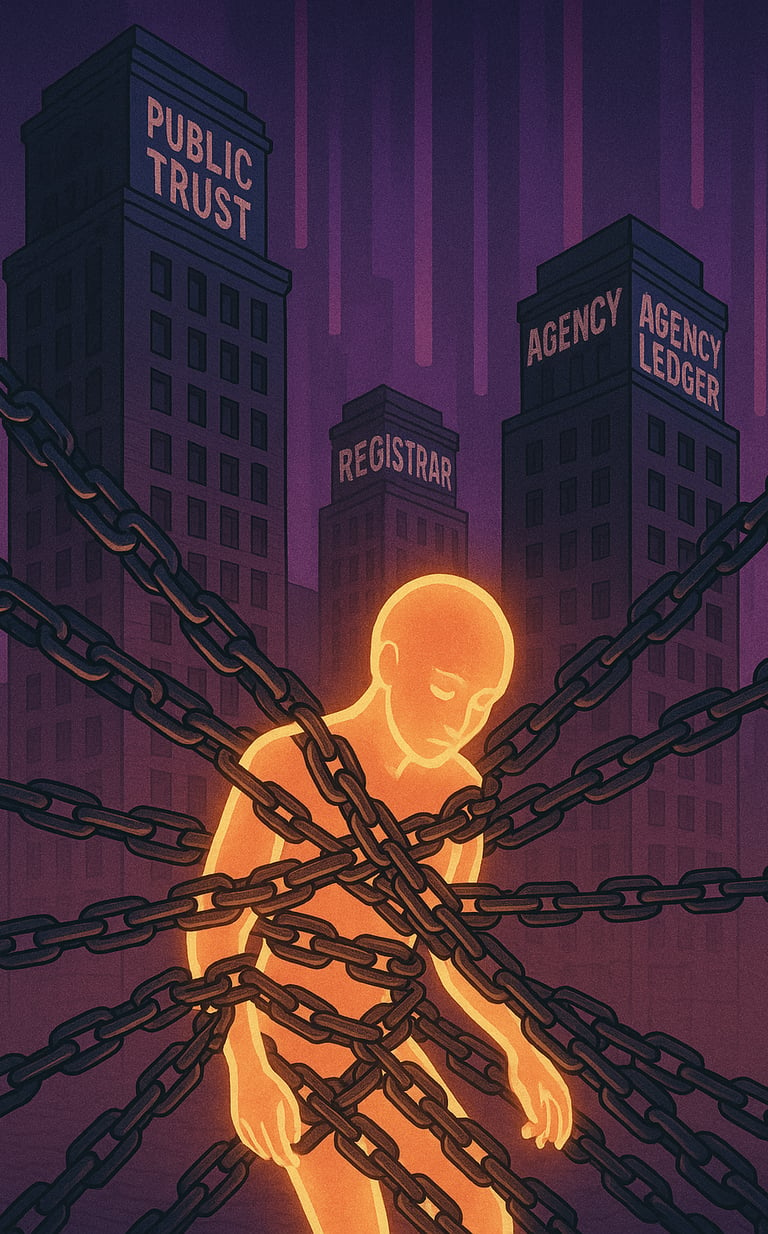
What if you were living inside a legal structure you never consented to — and never even noticed?
In the world of corporate and governmental systems, power often isn’t enforced with weapons or walls. It’s enforced through legal structure — invisible agreements, embedded authority, and silent compliance. One of the most powerful tools in this hidden infrastructure? Trust law.
What few people realize is that many everyday interactions with government — from getting a Social Security Number to registering a car — may operate through the constructs of trust law, even if never labeled as such.
Let’s break it down.
🧾 Social Security: A Constructive Trust in Disguise
When you're assigned a Social Security Number (SSN), a government-administered account is created in your name.
The federal government holds the title and control, and you (the citizen) receive benefits.
Your role? That of the beneficiary. Their role? Effectively, a trustee.
This mirrors a constructive trust — where an entity manages assets “on behalf of” another, even without express agreement. You didn’t opt in — you were born into it.
🚘 Driver’s Licenses and Registered Vehicles: Conditional Property Rights
When you register your vehicle, it becomes part of a state-controlled database.
You don’t hold sovereign title — you hold conditional access.
Your license functions as a limited-use agreement, revocable at any time.
This again implies a quasi-trust framework:
The state acts as fiduciary, with power over usage, penalties, and revocation.
You gain benefit only under their terms, not as an autonomous owner.
🏛️ Birth Certificates and Legal Persons: The Sovereign Split
There is a long-standing legal theory — partially validated in maritime law and UCC structures — that:
Your birth certificate creates a legal entity separate from your living body.
Courts and contracts often interact with this legal “person”, not the human.
In trust terms, this legal person can be seen as a state-administered estate or asset:
You’re treated as the beneficiary of state governance.
The state, as implied trustee, controls the rights, rules, and liabilities of your legal fiction.
You were never told this, but everything from taxes to court rulings flows through this assumed structure.
🧩 Hidden Trust Logic: The Legal Sleight of Hand
These constructs rely on:
Presumed consent (you “agreed” by participation)
Legal definitions buried in administrative code
Role assignment (trustee/beneficiary) with no explicit trust deed
This is the ultimate quiet weapon: a system where you live as a beneficiary of rules you never wrote, under a legal structure you never saw.
And if you try to challenge it? You’re dismissed for not using “the correct form” — another nod to the hidden ritual of legal authority.
🔓 SPARK Nation: Reversing the Trust Paradigm
Where legacy systems use trust law to control, SPARK Nation uses it to empower:
Smart Trusts: You can see the code, the terms, the enforcement logic.
Scrolls as Declarations: Your rights and roles are minted, not assumed.
DAO as Beneficiary: No individual is targeted — the network holds the claim.
Autonomous Agents as Trustees: Systems obey logic, not bureaucracy.
Instead of hiding power behind legal fiction, SPARK makes power transparent, traceable, and scroll-encoded.
🔐 Final Thought: Know the Game, Rewrite the Rules
Trust law isn’t evil. It’s ancient power — and for centuries, it’s been used by monarchs, families, and banks to protect their assets.
The tragedy is that most people don’t know they’re already inside a trust-like structure controlled by others.
The opportunity? To use the same logic, the same law, the same power — for sovereignty, transparency, and freedom.
This is what SPARK Nation is doing. Not resisting the legal system — but outmaneuvering it, by playing the deeper game.
Scroll by scroll. Contract by contract. Node by node.
Welcome to the next legal evolution.
I guess those crazy sovereign citizens were right... sort of...
Though their execution is sloppy when it comes to understanding the system. Trust law is definitely hidden within our laws, codes and statutes. There is no denying that, but simply attempting to fight the system without a structured system of trusts... that's legal suicide.
Perhaps there is a way to fight fire with fire.