
The Battle for Web3 Identity: Decentralized Identity & Privacy Explained
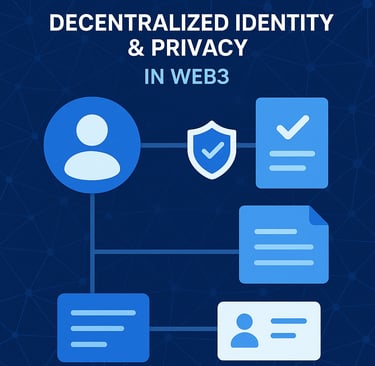
Decentralized Identity at a glance.
BLOCKCHAINDATA/DATA STORAGE
DION
6/21/20253 min read

Why Identity Is the Final Boss of Web3
In today's internet, your identity is fragmented across dozens of platforms—most of which you don't control. Social media, banks, governments, online retailers, and data brokers collect and sell your personal information. Massive data breaches are common, and users have little say over who can access or monetize their data.
Web3 introduces a new paradigm: self-sovereign identity (SSI). Instead of corporations owning your data, decentralized identity allows you to fully control your personal information, credentials, and digital footprint. In Web3, you become the owner of your identity.
The Problem with Traditional Digital Identity
Centralized Databases: Vulnerable to hacks, leaks, and misuse.
Data Exploitation: Personal data sold to advertisers and unknown third parties.
Redundant KYC: Repetitive identity verification across different platforms.
Fragmentation: No universal, portable identity across services.
Lack of Privacy: Full personal data often exposed during verification processes.
What Is Decentralized Identity?
Decentralized identity enables individuals to control their digital identity without relying on centralized authorities. Instead of handing over full personal data, users share only the necessary proofs when required—for example, proving you're over 21 without revealing your full birthdate.
This model uses:
Blockchain: To anchor verifiable credentials and identifiers.
Cryptography: To secure data and enable selective disclosure.
Zero-Knowledge Proofs (zkProofs): To prove facts without revealing sensitive information.
The Core Components of Decentralized Identity
Decentralized Identifiers (DIDs)
Unique, cryptographically secure identifiers owned by the user. They serve as the foundation of decentralized identity.
Verifiable Credentials (VCs)
Digitally signed credentials issued by trusted parties (e.g., universities, governments, employers) that can be selectively shared.
Zero-Knowledge Proofs (zkProofs)
Allow users to prove facts (like age, citizenship, or income level) without revealing underlying personal data.
On-Chain and Off-Chain Storage
Sensitive personal data is typically stored off-chain in secure wallets or encrypted storage, while the blockchain holds verification pointers and credential metadata.
Key Projects Leading the Charge
Ethereum Name Service (ENS): (https://ens.domains) Simplifies Web3 identity using human-readable wallet names.
Polygon ID: (https://polygon.technology/polygon-id) zk-based decentralized identity framework.
Worldcoin: (https://worldcoin.org) Biometric-based global identity protocol using iris scanning (controversial).
Civic: (https://www.civic.com) Identity verification and reusable KYC.
Bloom: (https://bloom.co) Decentralized credit scoring and identity.
BrightID: (https://www.brightid.org) Web-of-trust based identity verification.
KILT Protocol: (https://www.kilt.io) Web3 credentials, self-sovereign identity, and reputation management.
Benefits of Decentralized Identity
Data Ownership: Users own and control their personal data.
Selective Disclosure: Share only what’s necessary.
Interoperability: Use the same credentials across multiple platforms.
Faster Onboarding: Reuse verified credentials instead of repeating KYC.
Enhanced Privacy: zkProofs minimize unnecessary data exposure.
Fraud Reduction: Prevent identity theft with cryptographic security.
Challenges & Limitations
Regulatory Frameworks: Governments still developing legal standards.
User Adoption: Education required for mainstream adoption.
Standardization: Competing protocols need interoperability.
Biometric Data Concerns: Collection of biometric data introduces privacy risks.
Issuer Trust: Trust in credential issuers must be established and maintained.
Potential Surveillance Misuse: Poor implementation could enable surveillance if not designed ethically.
The Future of Web3 Identity
Web3 Passports: Global identity systems for cross-border services.
Reusable KYC: Verify once, reuse everywhere.
AI-Powered Identity Management: Personal AI agents controlling identity data sharing.
Credentialed Metaverse Avatars: Verified identity within virtual worlds.
Government Adoption: Countries exploring decentralized identity standards.
Healthcare, Employment, and Education Credentials: Secure, verifiable, and portable certifications.
Conclusion: Digital Identity Becomes Personal Again
"In Web3, you aren’t the product — you’re the owner of your identity."
Decentralized identity holds the potential to restore privacy, reduce fraud, simplify digital life, and create universal, user-owned identity systems. As Web3 scales globally, identity and privacy may become its most important foundation layer.
Further Reading & References
Ethereum Name Service (ENS): https://ens.domains
Polygon ID: https://polygon.technology/polygon-id
Worldcoin: https://worldcoin.org
Civic: https://www.civic.com
Bloom: https://bloom.co
BrightID: https://www.brightid.org
KILT Protocol: https://www.kilt.io
W3C DID Core Specification: https://www.w3.org/TR/did-core/
Web3 Identity: The Missing Layer of Web3 (Coinbase): https://www.coinbase.com/learn/crypto-basics/web3-identity