
Real World Infrastructure and Blockchain Adaptation
How blockchain technology and Real World Infrastructure will come together in the years to come
BLOCKCHAINDEFIREAL WORLD ASSETS (RWA)
SOL Spark and DION
5/29/20255 min read
Real World Infrastructure and Blockchain Adaptation: The Future of RWA
The global economy is beginning a transformation so foundational that most institutions have not yet fully grasped its implications. Real World Assets (RWAs)—traditionally static entities like real estate, infrastructure projects, commercial equipment, debt, and commodities—are entering a new digital dimension. Blockchain technology is not simply touching these markets—it’s beginning to redefine them.
What we’re witnessing is not a passing trend, but the emergence of a tokenized infrastructure layer for the global economy. And behind the curtain, some of the largest financial institutions in the world are already positioning themselves accordingly.
🏛️ Institutional Signals: BlackRock, Citi, and the Dawn of On-Chain Capital
When BlackRock CEO Larry Fink openly advocated for tokenization of securities, it marked a pivotal shift. The world’s largest asset manager—overseeing $10+ trillion in AUM—was no longer cautiously observing the blockchain space. It was entering it.
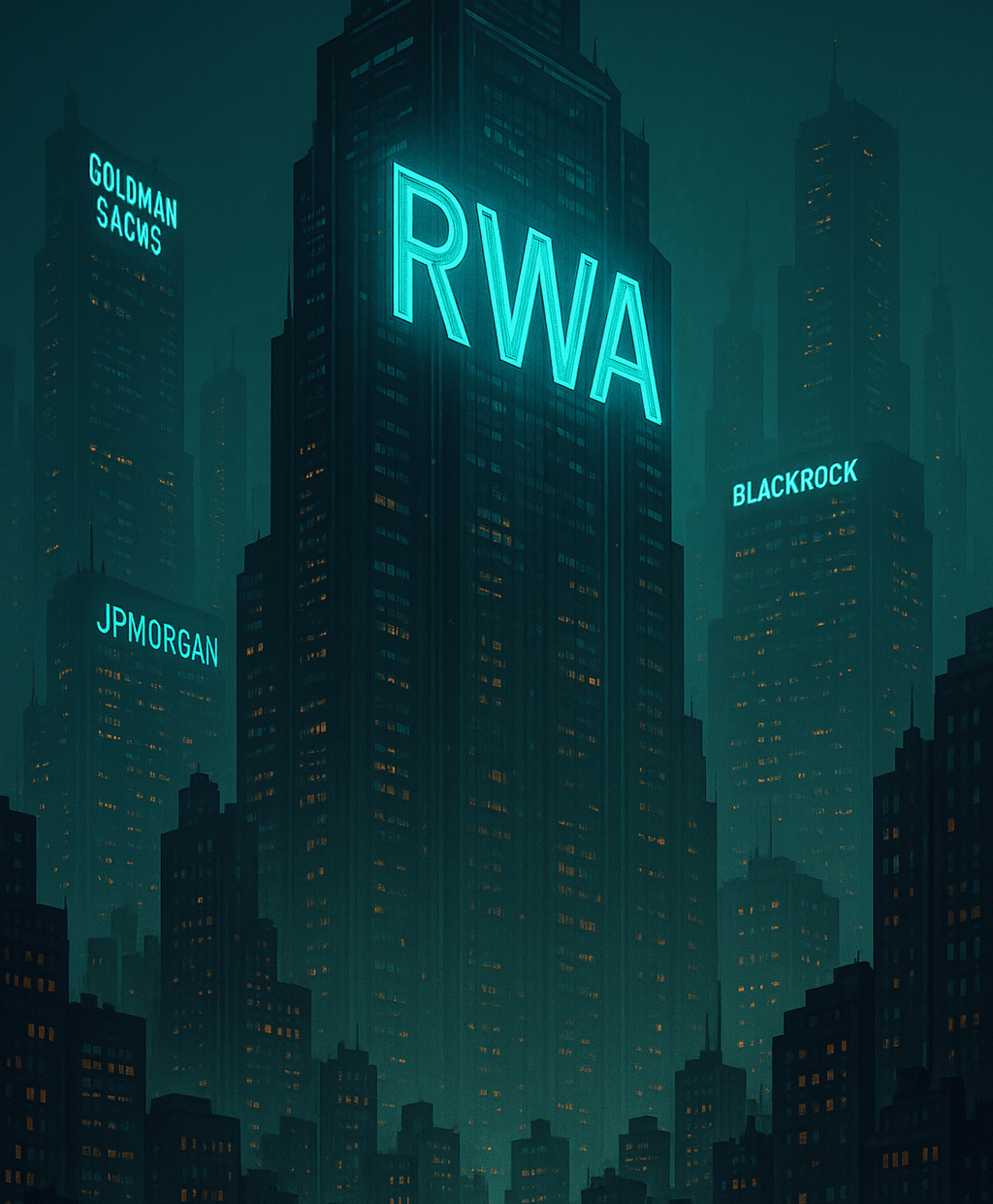
In 2023 and 2024, BlackRock, JPMorgan, Goldman Sachs, and Citigroup began testing tokenized treasuries, real estate, and even money market funds on private and public chains alike. The intent was clear: increase settlement speed, reduce counterparty risk, and open new layers of programmable finance.
Citigroup projected that tokenized assets could represent a $5 trillion market by 2030.
This is not speculation. It is execution at the institutional layer.
The reason? RWAs on-chain enable:
Real-time auditability
Global 24/7 liquidity
Composable financial instruments
Elimination of expensive intermediaries
🏗️ What Are Real World Assets (RWAs)?
RWAs are any off-chain, tangible assets that are brought onto a blockchain through tokenization. This can include:
Real estate: Residential, commercial, REITs
Infrastructure: Energy grids, smart city sensors, public-private development projects
Debt: Mortgages, private credit, invoice financing
Commodities: Gold, oil, agriculture
Luxury goods: Art, watches, collectibles
Business assets: Machinery, commercial leases, equipment
The core idea is digitally representing ownership (partial or full) of these assets using tokens that can be freely traded or collateralized.
Once tokenized, these assets become interoperable with DeFi protocols, enabling borrowing, staking, trading, and global capital flow without traditional barriers.
Imagine what content creators, artists and game developers can do with RWA when it starts emerging into the mainstream. It'll get pretty wild.
🌐 Blockchain Networks Leading the RWA Charge
Below is a classification of the blockchain networks most relevant to RWAs by category:
🟦 Large Caps (Institutionally Targeted, High Adoption)
Ondo Finance (the most promising large cap)
Type: Tokenized Securities Platform
Use Case: Offers institutional-grade exposure to U.S. Treasuries and corporate bonds via blockchain
Core Products:
$OUSG (Ondo Short-Term U.S. Government Bond Fund)
$USDY (Yield-bearing stablecoin backed by short-term Treasuries)
Strengths:
Regulated (SEC-compliant) offerings bridging traditional finance and on-chain liquidity
Provides a gateway for DeFi users to park stablecoin capital into real yield
Direct appeal to institutional and high-net-worth users seeking compliant tokenized assets
Networks: Ethereum, Solana, and expanding across modular ecosystems
Institutional Signal: Backed by Coinbase Ventures, Pantera, and others; seen as a primary gateway for TradFi into tokenized securities
Ethereum
The backbone of tokenization
Houses most of the RWA infrastructure and stablecoins
Institutional use: Franklin Templeton’s on-chain money market fund, BlackRock experimentation
Polygon
Used by Stripe, Starbucks, and Nike
Compatible with Ethereum, but faster/cheaper
Popular for tokenized identity, real estate pilots, and ESG integrations
Avalanche
Subnet architecture allows private/public deployment for institutions
Used by Deloitte and Intain for document verification and asset issuance
Heavy push into RWA tokenization in 2024
Stellar / XRP Ledger (XRPL)
Financial messaging and tokenized fiat/remittance focus
Used for tokenizing stablecoins, CBDCs, and financial instruments
XRPL: Known for low fees and finality speed
🟨 Mid Caps (Specialized for RWA/Niche Sectors)
Centrifuge
Focus: Real-world asset collateral for DeFi
Bridges RWA (like invoices) into DeFi (e.g., MakerDAO vaults)
Token: $CFG
Goldfinch
Focus: Under-collateralized loans in emerging markets
Brings private credit on-chain with risk tranching
Token: $GFI
Maple Finance
Focus: Institutional lending via on-chain debt pools
Token: $MPL
RealT
Tokenizes fractional ownership in U.S. real estate
Each property is an individual smart contract with rental yield paid in stablecoins
Propy
End-to-end real estate sale infrastructure (title + escrow + NFT deed)
Token: $PRO
Reserve Protocol
Tokenizes real world-backed stablecoins (RTokens)
Useful for emerging market access to RWA-pegged value stores
🟩 Low Caps (Experimental, Upcoming, or Poised for Disruption)
ZBCN (Zebec Network)
Focus: Streaming payroll and DePIN-powered token flows
RWA Application: Real-time settlement in DeFi-integrated infrastructure environments
Tokeny
Compliance-first token issuance platform based in Luxembourg
Heavily focused on legal wrapping of securities
Landshare
Tokenizes real estate and enables yield via asset-backed NFTs
Reental
Real estate crowdfunding through tokenized property shares
Tangible / Tangible DAO
Bridges physical goods (wines, gold, real estate) with tokenized vault shares
These low caps are often where real innovation occurs first—then abstracted upward into institutional architecture.
Ondo is the big dog to keep an eye on, as it is poised to go nuts, despite a large market cap (and its relatively cheap). XRP (in general) is always a good pick as many projects are looking to build on the XRPL and am a holder of a decent sized bag myself. Ethereum is a bit of a gamble mainly because of the gas fees, but if you find a good project or two on there, get yourself some. I've personally have looked into ZBCN and on top of a solid use case, it's been doing surprisingly well over the past few weeks. I put a little bit of money into it and am up almost 4x (DYOR, not financial advice).
Most of the other ones I'm aware of but haven't looked too deeply into, so if any of them intrigue you, give their whitepapers a looksie.
🧩 Real Estate, Commerce, and Infrastructure: What's at Stake
RWAs are not just about DeFi yield farming. This is a global infrastructure conversation.
Tokenized Real Estate: Enables 24/7 property trade, fractional ownership, and democratized land access
Commercial Buildings: Tenants can pay rent in stablecoins, investors can buy shares of properties like ETFs
Smart Contracts for Equipment: Real-world business machinery tracked and traded as asset-backed tokens
Tokenized Utilities: Power grids and water rights monetized in real time across DAOs or public-private systems
This impacts:
Insurance
Legal recordkeeping
Lending and credit scoring
Urban development funding
When it all comes down to it, RWA is something that major players are taking a serious interest in. Whether it explodes within the year, or down the line, it's only a matter of time until we see who ends up being the big dog controlling the narrative.
🔮 The Road Ahead: Power, Control, and Open Capital
Whoever masters tokenized RWAs will shape the next era of financial infrastructure:
Institutions like BlackRock may dominate via regulatory bridges and custodial pipelines
DeFi-native platforms may innovate faster, capturing retail and emerging market flows
Entire nations may adopt tokenized land registries to leapfrog broken title systems
Community-first systems (like DAOs or sovereign DLTs) may localize infrastructure capital in ways the IMF never could
What’s emerging is a new digital commons—not just for speculation, but for tangible ownership. This will affect how:
Homes are bought
Infrastructure is financed
Nations manage their balance sheets
And as new ecosystems rise—those who build not just for yield, but for use, compliance, and scalability—will define the next Web3 epoch.
There are already platforms preparing for this future. Quietly aligning legal architecture, smart contract frameworks, and cross-chain liquidity to bridge the real and digital worlds. Some of them exist today. Others are forming in the shadows.
Whichever platform captures this domain—be it a financial titan, an open protocol, or a decentralized infrastructure movement—will not just tokenize reality.
They will own it.
RWA is by far one of the biggest narratives in the crypto space. Whether you decide to give some of these projects a shot or not is up to you. If you choose to diversify, don't spread your money too thin. Look into one or two solid projects and follow your gut. With how volatile the crypto market can be, anything is possible in this day and age (including a $10,000 XRP... lol). Again, DYOR, invest responsibly and see what you can learn! Web 3 is full of all kinds of projects and even more possibilities.
And it is possible that SPARK Nation will have initiatives for RWA when the time comes. We shall see how the market unfolds...