
Blockchain x Supply Chain: How Web3 Is Fixing Global Logistics
Supply lines being move to blockchain
BLOCKCHAINMODERN AFFAIRS
DION
6/23/20253 min read
Why Supply Chains Are Broken
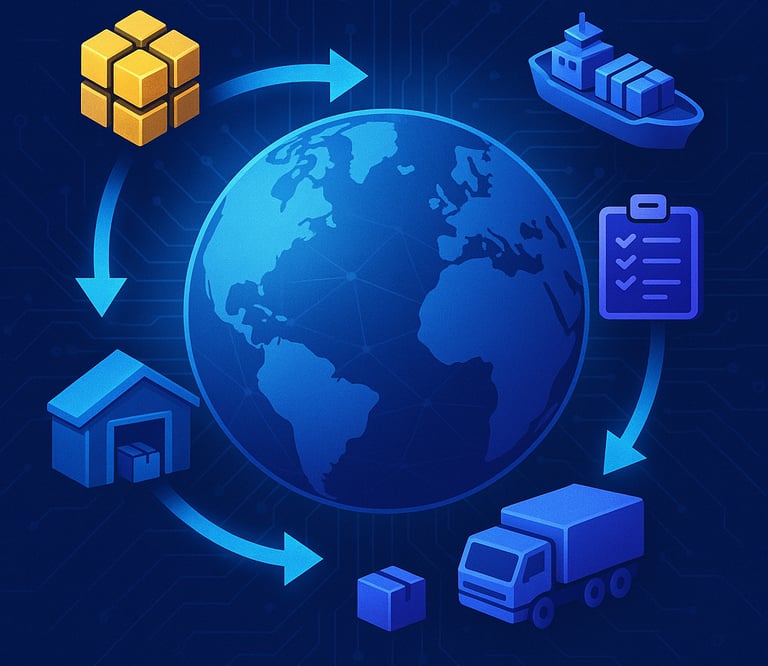
The COVID-19 pandemic revealed how fragile and complex global supply chains really are. From food shortages to medical equipment delays, billions of dollars were lost due to inefficient logistics, disconnected systems, and lack of transparency. Even before the pandemic, supply chains struggled with fraud, counterfeiting, and regulatory failures.
Traditional supply chains rely on dozens of disconnected databases, paperwork, brokers, and manual processes across multiple countries and vendors. Blockchain technology introduces a new layer of trust and transparency that can fix many of these long-standing issues.
The Pain Points of Traditional Supply Chains
Fragmented Data: Each party maintains its own records, often leading to conflicting information.
Counterfeiting: Fake luxury goods, pharmaceuticals, and electronics flood global markets.
Manual Reconciliation: Endless paperwork slows down cross-border shipments.
Slow Compliance: Customs and regulatory checks can take days or weeks.
Limited Traceability: Hard to identify where goods were produced, sourced, or contaminated.
Fraud & Corruption: Bribery, falsified documents, and hidden shipments increase costs and risks.
How Blockchain Solves Supply Chain Problems
Immutable Recordkeeping
Blockchain creates a tamper-proof ledger where every transaction, transfer, and certification is time-stamped and permanently stored.
End-to-End Visibility
All authorized parties — manufacturers, logistics companies, customs agents, regulators, and consumers — can view the status of goods in real-time.
Anti-Counterfeit Protection
Products can be tagged with digital certificates and scanned at every handoff, verifying authenticity throughout the entire supply chain.
Automated Compliance
Smart contracts can automate customs declarations, tax payments, and regulatory documentation.
Instant Audits
Regulators can perform audits instantly by accessing blockchain records, reducing corruption and oversight delays.
Fraud Reduction
Cryptographic security makes it extremely difficult to forge shipping documents or hide illicit shipments.
Core Supply Chain Blockchain Models
Public Blockchains: Open and transparent systems accessible to all participants.
Permissioned Blockchains: Private, consortium-based networks managed by trusted industry players (e.g., Hyperledger, Corda, Quorum).
Hybrid Models: Blend of public transparency with selective private data access for sensitive information.
Key Blockchain Supply Chain Projects
IBM Food Trust (https://www.ibm.com/blockchain/solutions/food-trust): Food supply chain tracking for Walmart, Nestle, and others.
VeChain (https://www.vechain.org): Luxury goods, pharmaceuticals, and agricultural traceability.
OriginTrail (https://origintrail.io): Decentralized knowledge graph for supply chain data interoperability.
TradeLens (sunset but influential): IBM & Maersk global shipping platform for port logistics.
Provenance (https://www.provenance.org): Sustainability and ethical sourcing verification for consumer products.
Everledger (https://everledger.io): Diamond, wine, and luxury goods authenticity tracking.
CargoX (https://cargox.io): Blockchain-powered digital bills of lading for global freight.
Industry Use Cases
Food Safety: Track freshness, contamination, and recall paths.
Luxury Goods: Authenticate designer products and prevent fakes.
Pharmaceuticals: Secure drug supply chains and prevent counterfeit medications.
Electronics: Verify sourcing of conflict-free materials and components.
Automotive: Ensure authenticity of parts and compliance with regulations.
Port Logistics: Automate customs clearance and cargo documentation.
Challenges to Adoption
Global Standards: Lack of uniform technical and legal standards between countries.
Cost for Small Suppliers: Smaller businesses may struggle with onboarding costs.
ERP Integration: Legacy enterprise software may resist integration.
Privacy & Regulation: Sensitive business data must be securely managed.
Governance: Deciding who manages permissioned networks can create power struggles.
The Future of Blockchain Supply Chains
Globally interoperable trade networks.
Full product life cycle tracking from raw materials to end-of-life recycling.
Consumer-facing QR codes offering complete product histories.
AI-powered supply chain optimization on blockchain data.
DAO-managed trade consortiums for global commerce.
Automated smart customs clearance across borders.
Conclusion: Global Trade Needs Trustless Transparency
"Blockchain isn’t replacing logistics — it’s making it honest."
As global trade becomes more complex, blockchain provides a neutral trust layer connecting manufacturers, logistics providers, regulators, and consumers in real-time. The result is a more secure, efficient, and transparent supply chain that can adapt to the demands of a connected global economy.
Further Reading & References
IBM Food Trust: https://www.ibm.com/blockchain/solutions/food-trust
VeChain: https://www.vechain.org
OriginTrail: https://origintrail.io
Provenance: https://www.provenance.org
Everledger: https://everledger.io
CargoX: https://cargox.io
WEF Blockchain for Supply Chains Report: https://www.weforum.org/whitepapers/blockchain-beyond-the-hype
Deloitte Blockchain in Supply Chain: https://www2.deloitte.com/global/en/insights/focus/industry-4-0/blockchain-supply-chain.html
Despite Dion utilizing sources from the WEF and other "similar minded" sources (I still don't trust those egg headed spitfucks), the one thing that they have going for them is providing useful information in regards to blockchain. Do I trust their true motives? Hell no. I'm only utilizing information to help with educational purposes. Doesn't mean I align with them.
Agree to disagree, I guess?